
"Dear Postal Customer" ...
As philatelic sleuths we can figure out a lot of things, but a letter sure helps!

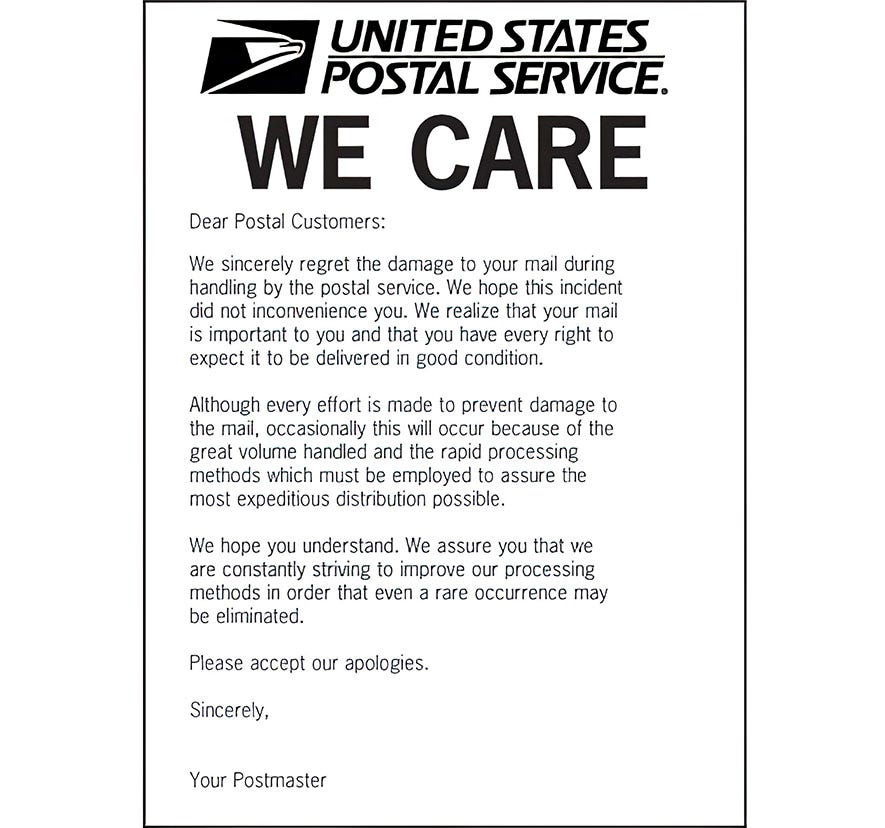
As you may know, one of my favorite areas of postal history is the vast world of auxiliary markings and navigating reasons for delay or non-delivery of mail. Although many auxiliary markings can help us “read” a cover, many do not, and many covers don’t even have markings to explain damage. This is particularly true with modern-day so-called “body bags” that come with a printed generic apology, but no explanation why your mail was mangled. An example of one of these is shown below, in Figure 1.
But that hasn’t always been the case, and I’d like to share a couple of interesting items with you today. In some cases, special letters have been created to explain delay or damage to mail. This was usually done when there was either a large amount of mail affected, or if the circumstances were unusual.
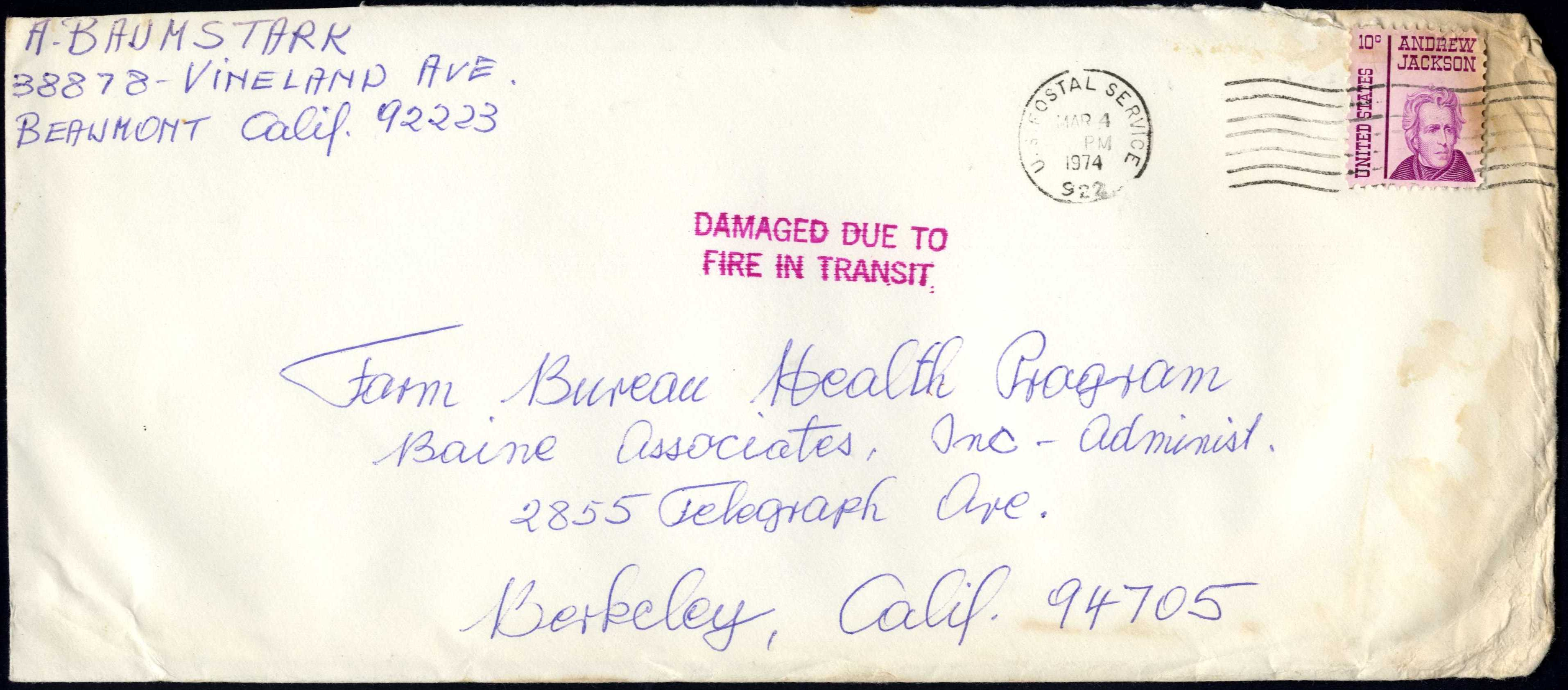
Shown in Figure 2 is a cover from 1974 with an auxiliary marking that pretty well explains what happened: “DAMAGED DUE TO FIRE IN TRANSIT.” While the cover, which was traveling from Beaumont, Calif., to Berkeley (a distance of about 450 miles) shows no sign of singeing, it is clearly water damaged — no doubt from the “cure.” It’s the letter that accompanied it that fills in the cracks.
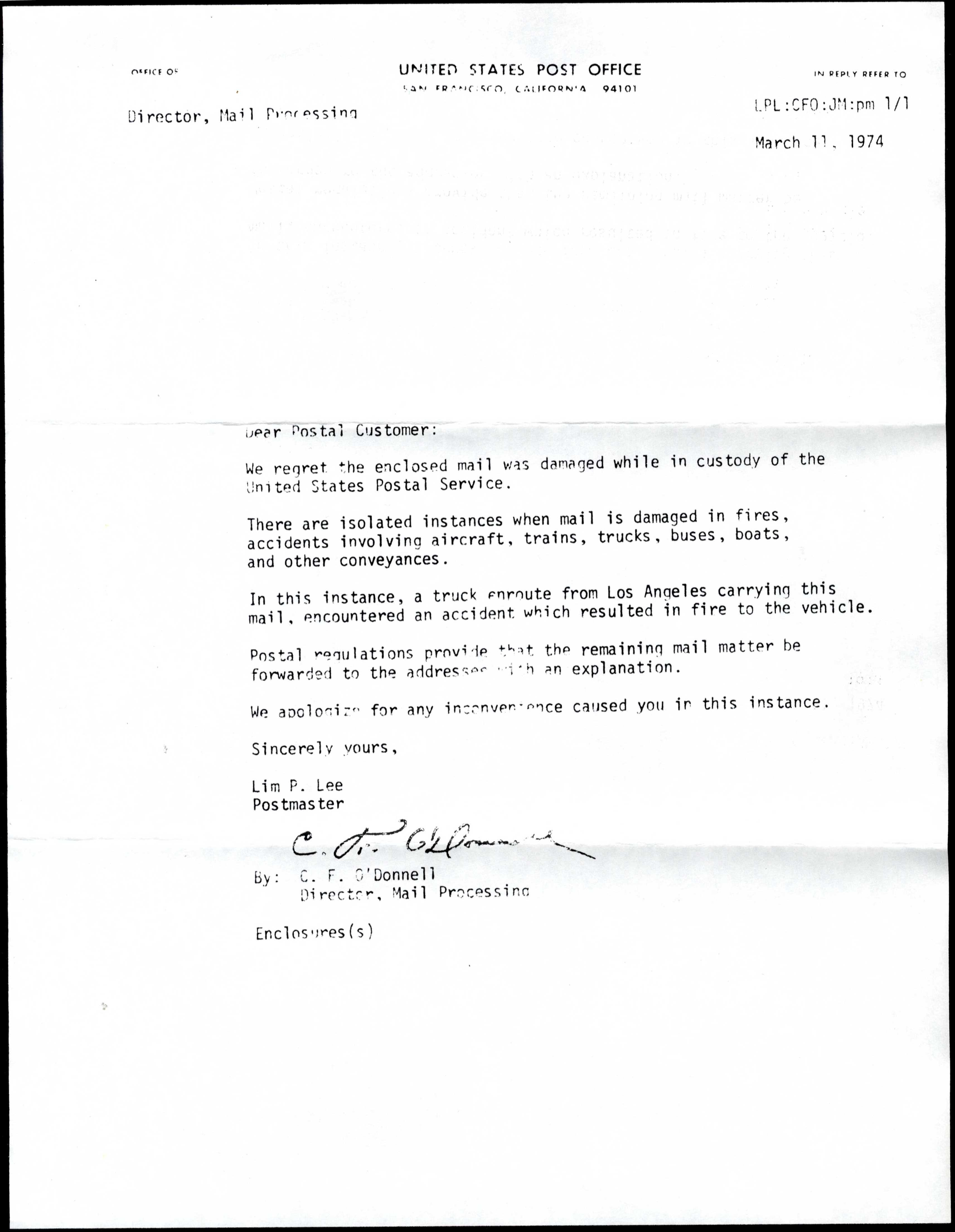
The letter, shown in Figure 3, is dated March 11, 1974, a week after the cover was mailed, and was sent from the San Francisco post office. The key part of this “Dear Postal Customer” letter reads: “There are isolated instances when mail is damaged in fires, accidents involving aircraft, trains, trucks, buses, boats, and other conveyances.
“In this instance, a truck enroute from Los Angeles carrying this mail, encountered an accident which resulted in fire to this vehicle.”
Indeed! According to an article in the March 13, 1974, The Peninsula Times Tribune (San Francisco Peninsula), a 42-foot mail truck overturned March 5, 1974, near Coalinga (about halfway between Los Angeles and San Francisco; the gas tank ruptured and the truck “burst into flames.” That complete newspaper article is shown in Figure 4. “It was a hell of a mess,” stated Mike Rucinski, general foreman of mails at the main San Francisco post office. The truck was carrying close to 5,000 pounds of first-class mail (between 400-500 bags), most of which was burned beyond recognition, according to a later U.S. Postal Inspection Service report. The mail that was salvageable was dried out, repacked and sent off to recipients with the form letter shown in Figure 3.
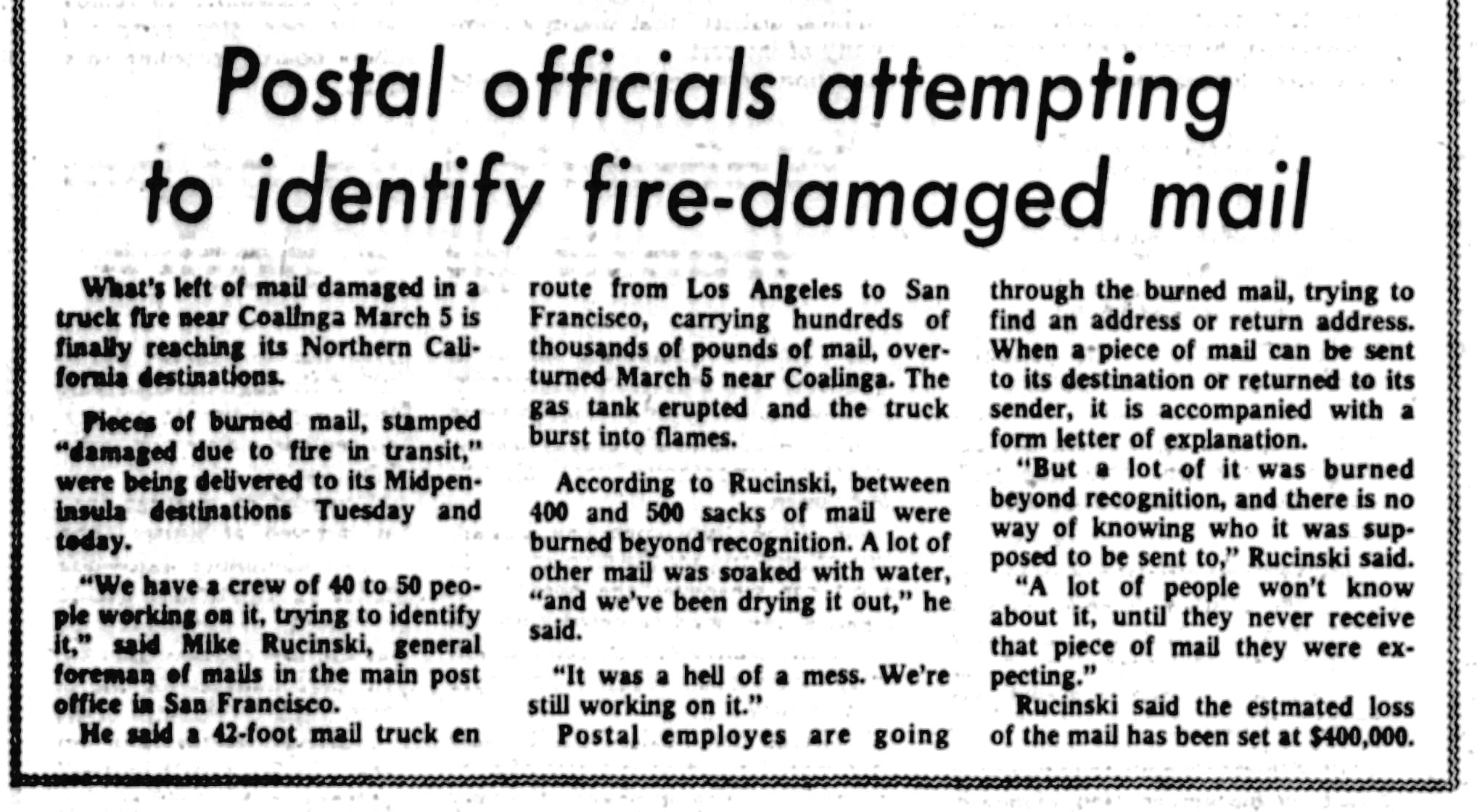
Almost comically, Rucinski stated, “A lot of people won’t know about it, until they never receive that piece of mail they were expecting.” This is the only piece of mail from that crash I’ve seen, but without the letter, much of the identity of this cover would have been lost.
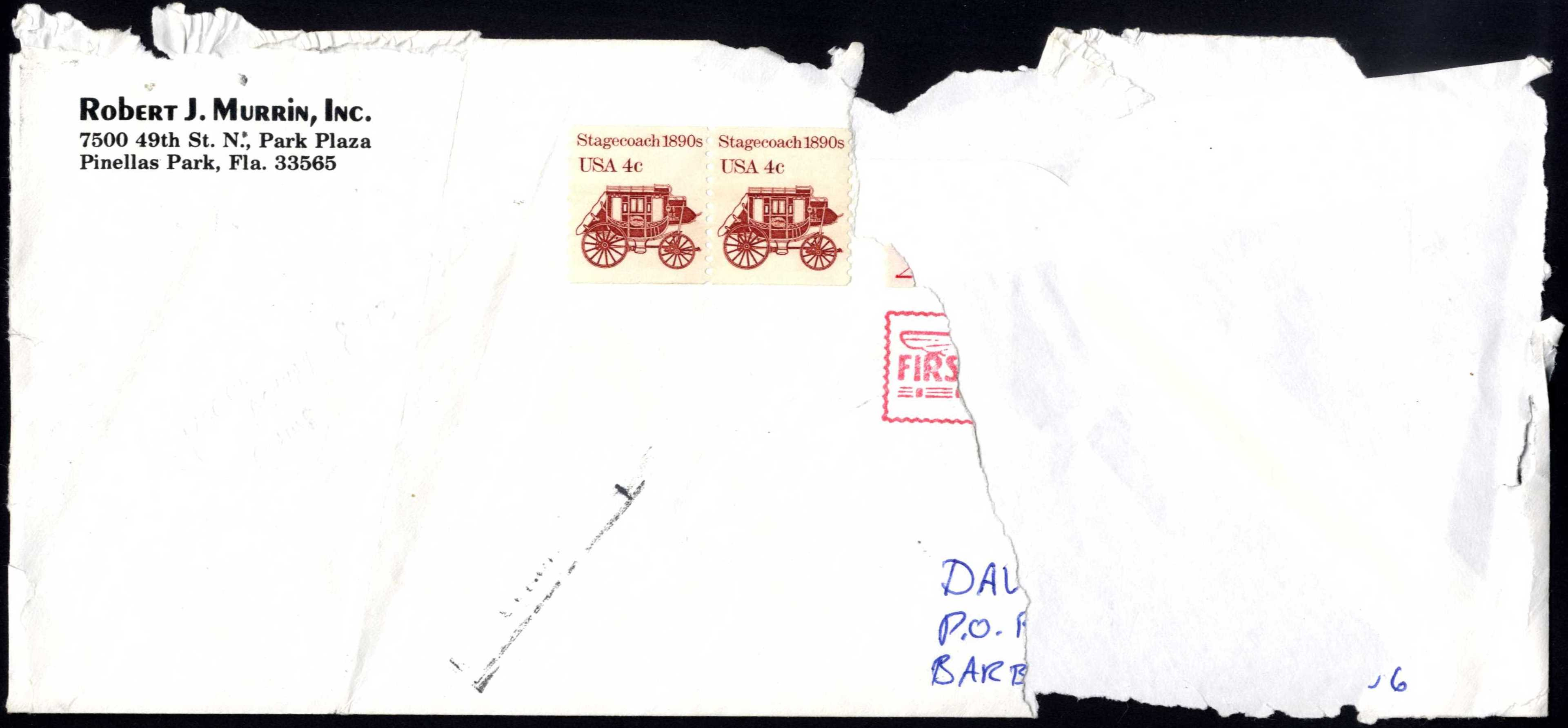
Similarly, the partial 1983 cover shown in Figure 5 would literally be nothing, without the postmaster letter that accompanied it when it was returned to the sender. There is no date, no postal markings, no auxiliary markings, no address and only a pair of uncanceled 4¢ Stagecoach coil stamps remaining (and the corner of a 5.2¢ Sleigh stamp just to the right of the pair).
The “Dear Postal Customer” letter that accompanied this item is dated Sept. 8, 1983, from Postmaster H.W. Scott of Saint Petersburg, Fla. It is shown in Figure 6. Notably, a mint block of four 5¢ “clean-faced” Washington stamps from the Prominent Americans series (Scott 1283B) is taped near the top. In that letter, shown in Figure 6, Scott explains the use of certain high-speed mail-processing equipment results in the inevitable damage to some mail. “Because of the extent of this damage to your mail piece,” Scott wrote, “we are unable to determine the identification of the addressee or intended delivery point, therefore we are enclosing a postage refund.”
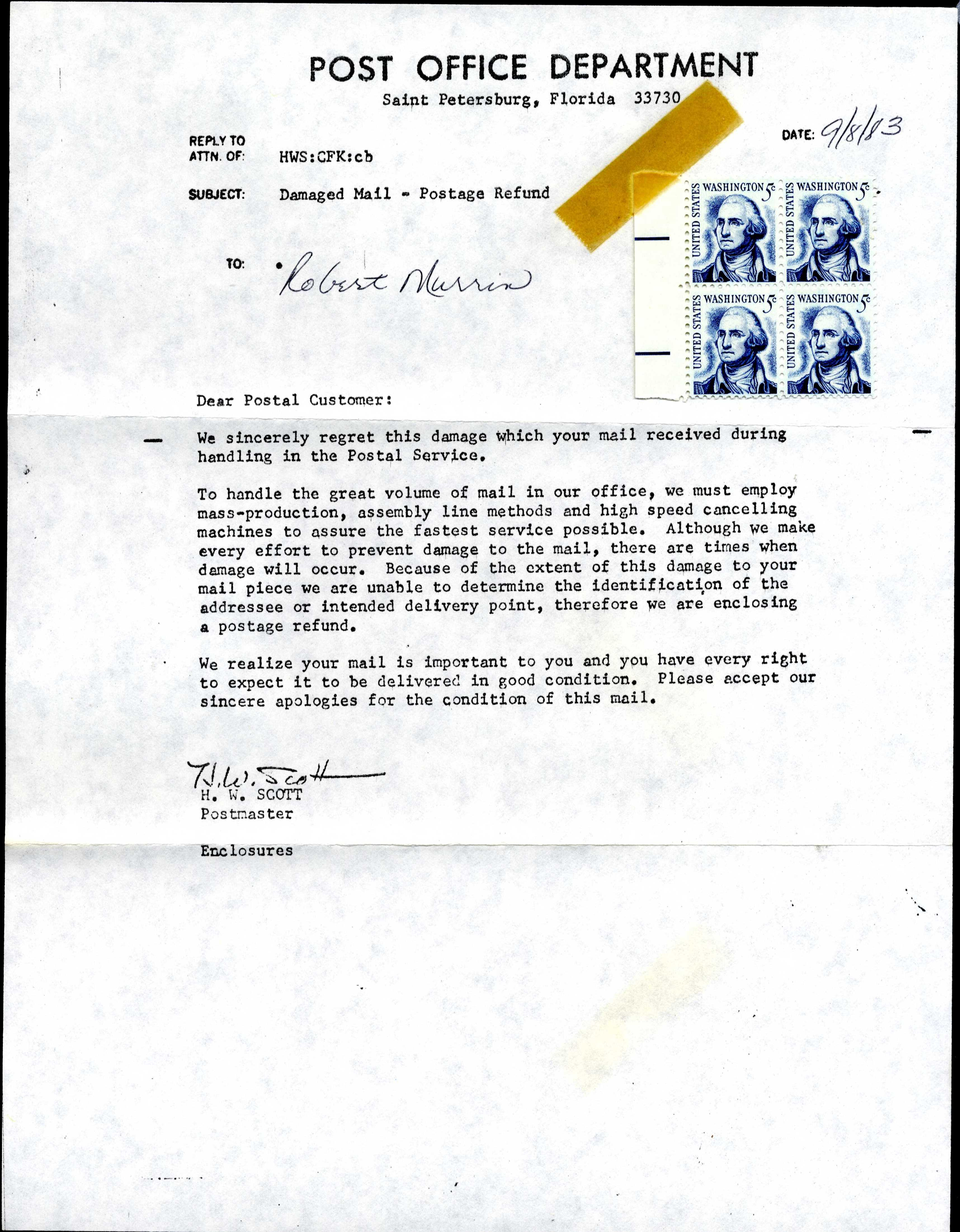
I’ve never seen this USPS practice before. What’s even more interesting to me is that this is a photocopied form letter, with only the name and date written in, which indicates this was far from an isolated incident.
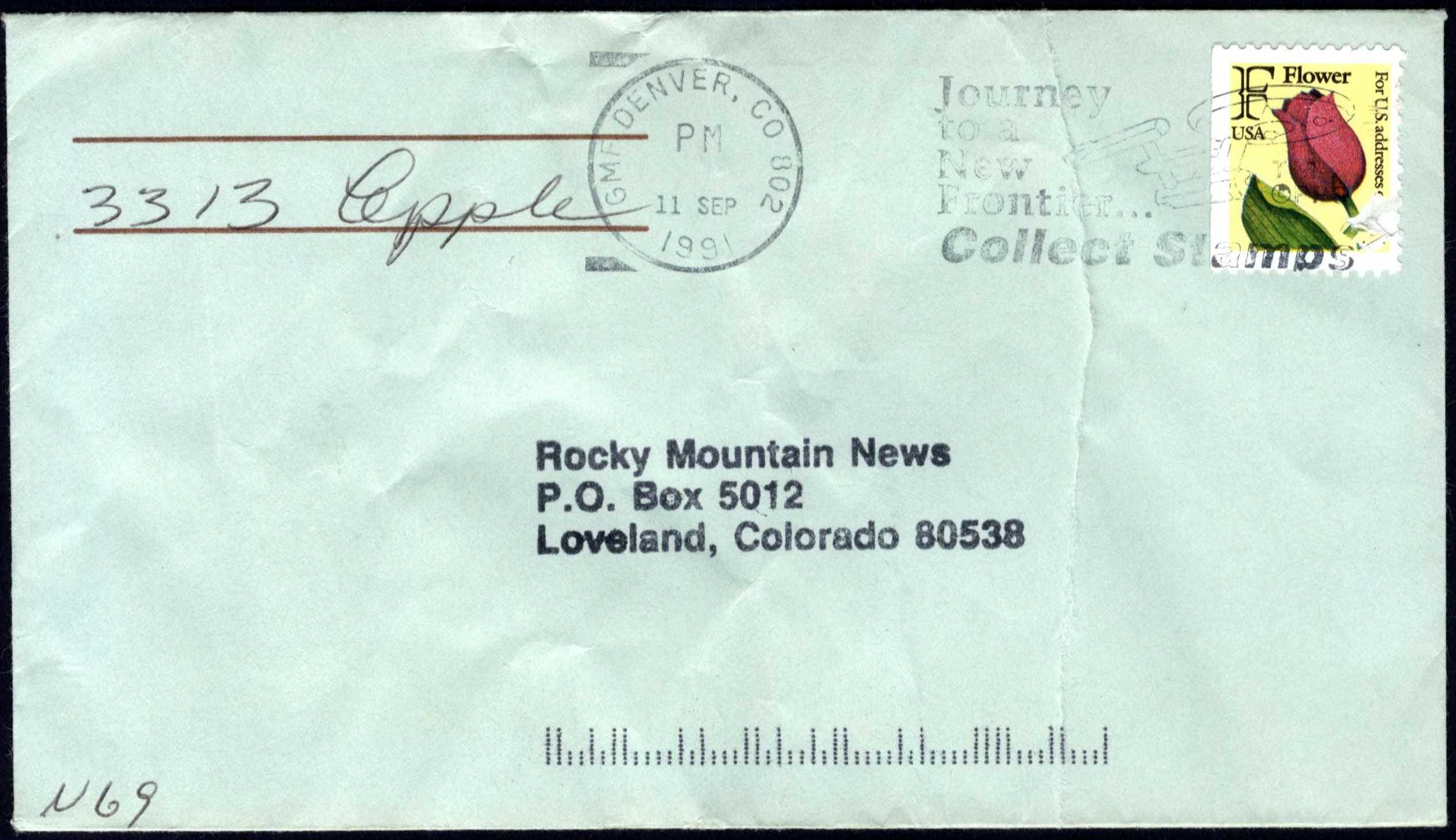
Finally, let’s take a look at the 1991 cover shown in Figure 7. Other than the fact it was clearly ripped open and the stamp is damaged at lower right, there’s nothing apparently unusual about it. Other than the Sept. 11 postmark and bar code, there are no other markings.
However, the “Dear Postal Customer” letter shown in Figure 8 explains everything. It is printed on “Postal Inspector” stationery, dated Oct. 7, 1991, nearly a month after the cover was mailed, and signed by L.E. Morris, a postal inspector in Denver, Colo.
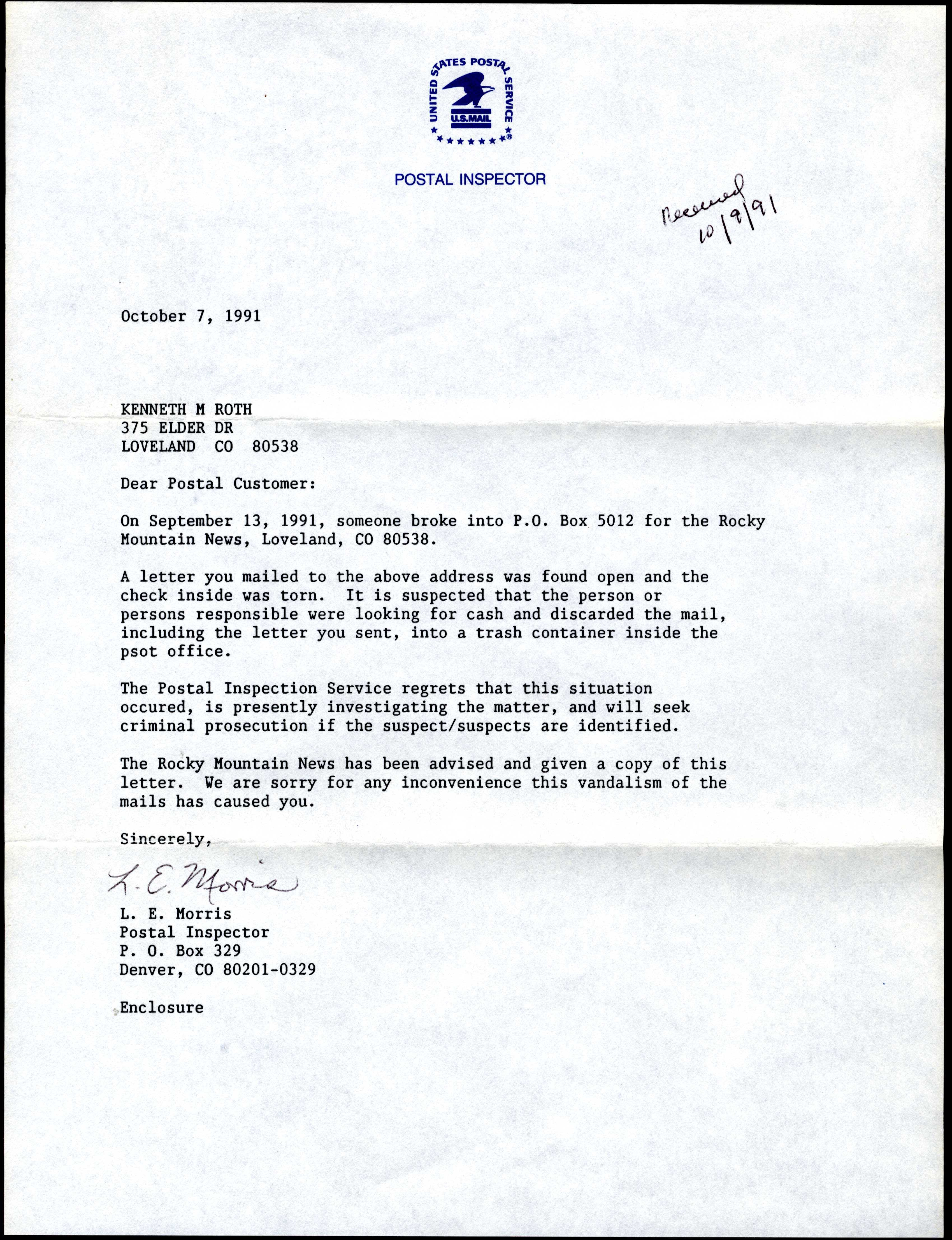
It seems our subject cover was part of a mail theft. “On Sept. 13, 1991, someone broke into P.O. Box 5012 for the Rocky Mountain News, Loveland, CO 80538,” the letter begins. It goes on to describe that mail taken from the post office box was ripped open in search of cash, with all mail discarded in a trash can in the post office.
Although I was unable to determine if a subject was ever apprehended, the postal inspector made it clear that the Postal Inspection Service would seek criminal prosecution.
Once again, without the “Dear Postal Customer” letter, the significance of this cover would be completely lost, and a modern-day plastic “Dear Postal Customer” body bag doesn’t come anywhere near providing important information regarding damage or delay to the mail. Occasionally, some heavy-duty sleuthing based on date and location can turn up more information, but that’s the exception, rather than the rule. I wonder just how many stories have been lost.